Image not available
Gifts & decor
Zinc Sulfide (ZnS)
<p>Zinc sulfide (ZnS) is an important compound semiconductor material that finds numerous applications in the optical domain, particularly in the UV and visible regions, due to its wide bandgap, high refractive index, and good chemical stability. </p><p>Its unique properties make it suitable for a wide range of applications, including optics, coatings, scintillators, electroluminescent devices, and photocatalys…
SupplierHT Optics Technology Co. LLC.www.htoptics-tech.com
Source categories
About this product
Product information from the supplier.
Crystal Structure and Properties
-ZnS crystallizes in two primary structures: zinc-blende (cubic) and wurtzite (hexagonal).
-It has a wide direct bandgap of 3.6 eV (zinc-blende) and 3.9 eV (wurtzite) at room temperature, making it suitable for applications in the ultraviolet (UV) and visible spectral regions.
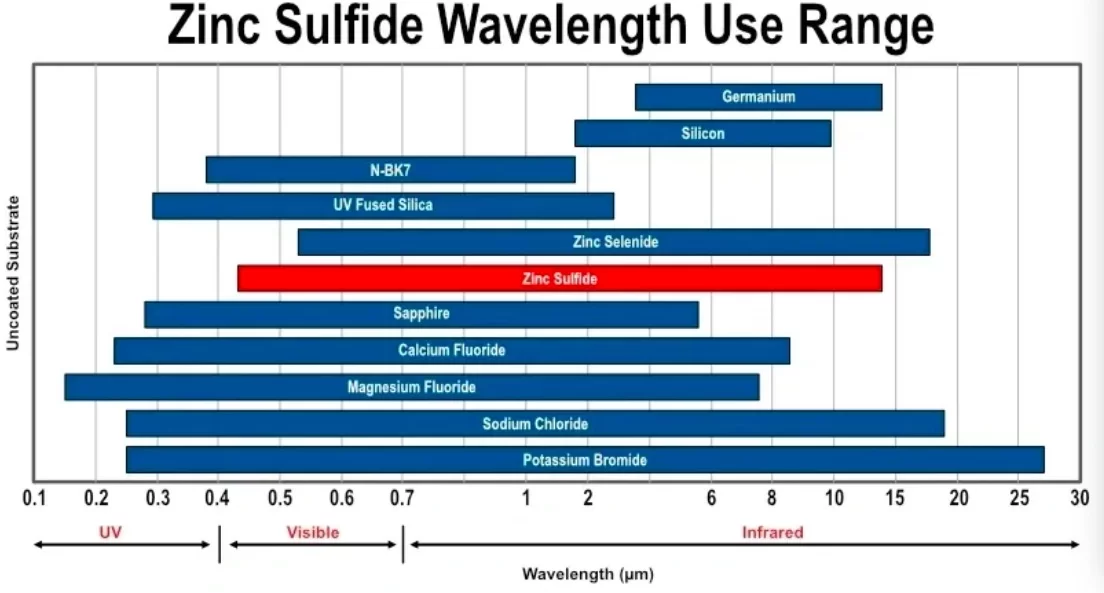
-ZnS exhibits high transparency in the visible and near-infrared regions, with a transmission range from 0.4 μm to 12 μm.
-It has a relatively high refractive index of approximately 2.35 in the visible range, which is useful for optical components requiring high refractive index materials.
-ZnS has good chemical stability and resistance to moisture, making it suitable for harsh environments.
Optical Applications
-UV Optics: ZnS is widely used for optics in the UV region, such as lenses, windows, and filters, due to its wide bandgap and good UV transparency.
-Optical Coatings: ZnS is commonly used as a material for optical coatings, such as antireflective coatings, high-reflective coatings, and beam splitters, in the visible and near-infrared regions.
-Scintillators: ZnS doped with certain activators (e.g., silver, copper) is used as a scintillator material for radiation detection and imaging applications.
-Electroluminescent Devices: ZnS is utilized in the fabrication of thin-film electroluminescent displays and lighting devices.
-Photocatalysis: ZnS nanoparticles and thin films are used as photocatalysts for various applications, such as water splitting, pollutant degradation, and solar energy conversion.
Fabrication and Processing
-ZnS can be grown as bulk single crystals using techniques like chemical vapor transport (CVT) and physical vapor transport (PVT) methods.
-Polycrystalline ZnS can be produced by sintering or hot-pressing processes.
-Thin films of ZnS can be deposited using various techniques, such as chemical vapor deposition (CVD), sputtering, and molecular beam epitaxy (MBE).
Challenges and Limitations
-ZnS has a relatively low thermal conductivity, which can limit its use in high-power applications or situations requiring efficient heat dissipation.
-ZnS is susceptible to degradation in certain chemical environments, particularly in the presence of strong acids or bases.
More from this supplier
HT Optics Technology Co. LLC.