
Image not available

New energy
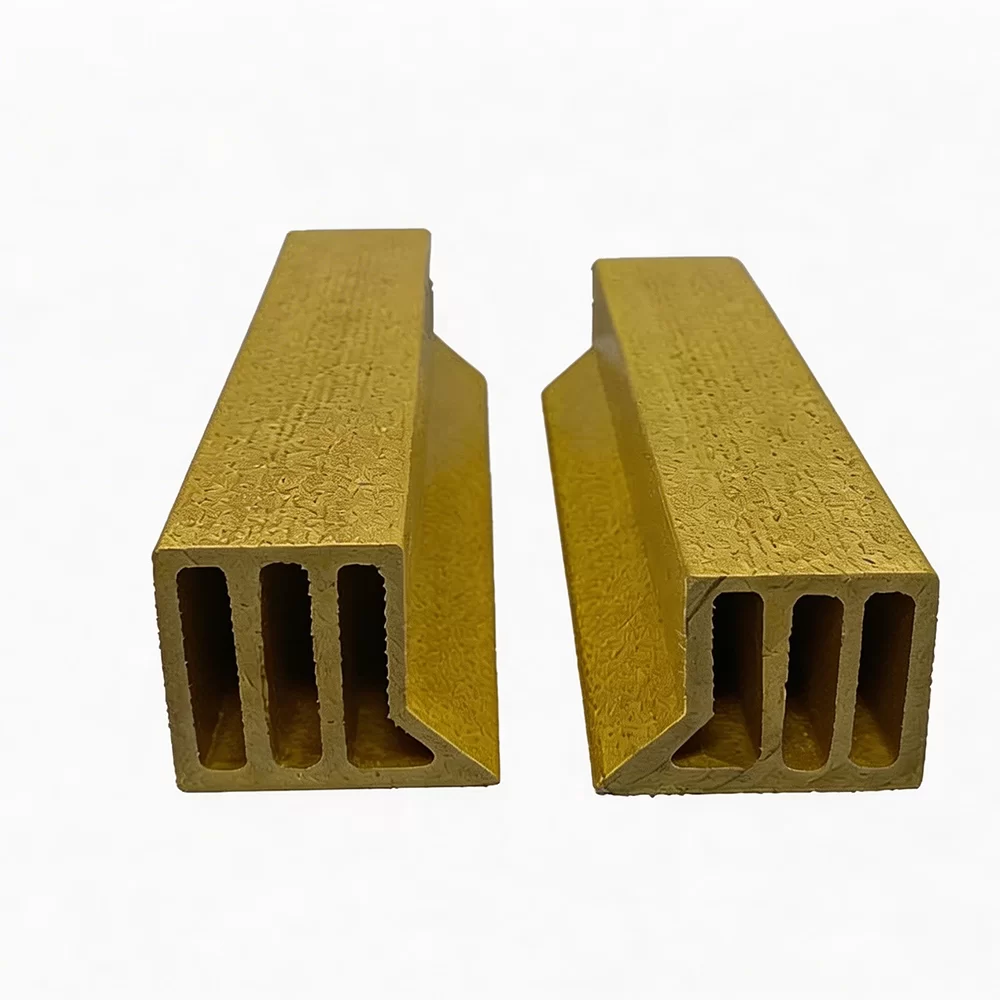
High Strength FRP Three Cavity Angular Profiles China Factory Suppliers
Leading China factory and suppliers of FRP three cavity angular extruded profiles. Our pultruded three-chamber composite angles offer superior corrosion resistance, high rigidity, and lightweight durability for industrial use.
SupplierHebei Zhongtian Composite Materials Group Co., Ltd.www.hbztcomposite.com
Source categories
About this product
Product information from the supplier.
FRP Three Cavity Angular Extruded Profiles represent a high-performance structural solution designed to replace traditional metals in demanding industrial and architectural environments. Utilizing a sophisticated pultrusion process, these profiles feature a unique three-chamber hollow design that significantly enhances rigidity and resistance to bending and compression, providing a lightweight yet robust alternative for frameworks and load-bearing structures.
Engineered for extreme durability, these composites offer exceptional corrosion resistance and non-conductive properties, making them indispensable for chemical plants, electrical substations, and infrastructure projects. By combining continuous longitudinal glass fibers with a high-grade resin matrix, our profiles ensure dimensional stability and long-term structural integrity, effectively reducing maintenance costs and increasing the lifespan of your installations.
Detailed Parameters
| Material Composition | Glass Fiber Reinforced Polymer (FRP) | Manufacturing Process | Precision Pultrusion |
|---|---|---|---|
| Structural Design | Three-Cavity Angular Hollow | Mechanical Property | High Strength-to-Weight Ratio |
| Electrical Property | Non-Conductive / Insulating | Thermal Property | Flame Retardant Options |
| Environmental Resistance | Corrosion & UV Resistant | Dimensional Stability | High Resistance to Deformation |
| Customization | Adjustable Wall Thickness & Size | Surface Finish | Smooth / Customizable Finishes |
Key Advantages
Superior Corrosion Resistance
Immune to rust and chemical erosion, outperforming steel in harsh industrial and coastal environments.
Low Maintenance Lifecycle
Eliminates the need for frequent painting or coating, drastically reducing long-term operational costs.
Enhanced Structural Rigidity
The three-cavity design increases resistance to twisting and bending compared to solid profiles.
Non-Conductive Safety
Acts as a natural insulator, providing critical safety in high-voltage electrical installations.
Lightweight Installation
Easily cut, drilled, and fastened, reducing labor costs and speeding up on-site assembly.
Eco-Friendly Sustainability
Efficient pultrusion process minimizes waste and reduces transportation energy due to low weight.
Product Gallery
Management Platforms
Industrial Frameworks
Ideal for machinery racks and conveyor systems in chemical plants.
Electrical Supports
Safe insulation for telecommunication towers and power substations.
Architectural Accents
Durable window frames and façade supports for modern buildings.
Infrastructure Projects
Long-span installations for roofing and suspended structures.
Modular Systems
Easy integration into prefabricated building and partition walls.
Protective Barriers
High-load capacity guards for manufacturing workshops.
Investment Return Comparison
| Comparison Metric | Traditional Steel | FRP Three Cavity |
|---|---|---|
| Corrosion Resistance | Low (Requires Painting) | Excellent (Inherent) |
| Weight / Handling | Heavy (High Labor) | Lightweight (Efficient) |
| Electrical Conductivity | Conductive (Risk) | Non-Conductive (Safe) |
| Maintenance Cycle | Frequent (High Cost) | Minimal (Low Cost) |
| Service Lifespan | Moderate (Rust Issues) | Extended (Decades) |
Frequently Asked Questions
Q: What makes the three-cavity design better than solid FRP profiles?
The three-cavity design significantly increases the moment of inertia, providing higher rigidity and resistance to bending and twisting while reducing the overall weight of the material.
Q: Can FRP profiles be used in high-voltage electrical environments?
Yes, FRP is inherently non-conductive, making these profiles an ideal and safe choice for electrical support systems, substations, and telecommunication towers.
Q: How do these profiles perform under extreme UV exposure?
Our FRP profiles are engineered with UV-resistant resins that prevent degradation and maintain structural integrity even under prolonged direct sunlight.
Q: Are the profiles customizable for specific project dimensions?
Absolutely. We offer customization for profile dimensions, cavity sizes, wall thicknesses, and surface finishes to meet your exact engineering specifications.
Q: What tools are required for on-site installation of FRP profiles?
FRP profiles can be easily handled using standard industrial tools for cutting, drilling, and mechanical fastening, which simplifies the installation process.
Q: Is the pultrusion process sustainable?
Yes, pultrusion is a highly efficient continuous manufacturing process that minimizes material waste and produces consistent, high-quality components with low energy footprints.
Ready to Upgrade Your Infrastructure with High-Performance FRP?
Contact UsMore from this supplier
Hebei Zhongtian Composite Materials Group Co., Ltd.


